October 11, 2026 · 6 min read
Crown molding installation cost: per foot, per room, and why corners matter
By the D&E Mako Renovation crew, Ephrata, PA. General guidance, not a quote for your house.
Professionally installed crown molding usually costs about $8 to $25 per linear foot in 2026 for paint-grade work, material and labor together. For a typical 12 by 14 foot room that has 52 feet of wall, that puts the job somewhere around $450 to $1,300 before paint. Stain-grade hardwood, built-up profiles and tall ceilings go higher. The numbers swing because crown is mostly labor, and the labor depends on your walls more than on the molding.
 BroomallMay 2025
The numbers, laid out
These ranges come from national cost guides such as Inch Calculator and inspection-industry pricing guides for 2026. Treat them as a starting point.
| What you are buying | Typical installed cost per linear foot |
|---|---|
| Simple paint-grade MDF or finger-joint pine, 3 to 4 inch | $8 to $14 |
| Larger paint-grade profiles, 5 to 7 inch | $12 to $20 |
| Stain-grade oak, poplar or maple | $15 to $30 |
| Built-up crown (two or three pieces stacked) | $20 to $40 |
| Polyurethane or foam crown | $6 to $12 |
Labor alone in those guides runs roughly $2.50 to $9 per foot, with most jobs near the middle. Painting is often a separate line, typically around $1 to $2.50 per foot. Rooms with many corners cost more than the per-foot math suggests, because corners are where the time goes.
We price crown by the room, with the wall length, the number of corners, the profile and the finish written on the estimate. That way you can see what changes if you pick a bigger profile or skip a room.
Why crown is mostly labor
Crown molding sits at an angle between the wall and the ceiling. That means every corner has to be cut on two angles at once, and every joint has to close on walls and ceilings that are almost never flat or square.
Three things eat the time:
- Corners. Inside corners are coped, which means one piece is cut to the exact profile of the other so the joint stays tight when the house moves. Outside corners are mitered and glued. A square room has four inside corners. A room with a bump-out, a chimney breast or a bay can have twelve.
- Uneven walls and ceilings. Old plaster ceilings dip and rise. A gap of a quarter inch along a run has to be closed by scribing, shimming or caulk that does not show.
- Long runs. Walls longer than one piece of molding need a scarf joint, which has to be placed and glued so it disappears after paint.
That is why a small, chopped-up room can cost as much as a large, simple one.
What raises the price
Ceiling height
Eight-foot ceilings are the base price. Nine and ten foot ceilings need taller ladders or planks and often a larger profile to look right. Two-story rooms and stair halls need staging.
Profile size and material
A 3 1/2 inch MDF crown is quick to handle. A 7 inch solid poplar crown is heavy, needs blocking behind it and needs two people on long runs. Stain-grade wood costs more twice: the material is more expensive, and every joint has to be perfect because there is no paint and caulk to hide it.
Blocking
Large crown is best nailed to a continuous triangular block fastened to the top plate and ceiling joists. It keeps the crown straight and gives solid nailing where there is no framing. Installing blocking adds time, and it is worth it on anything over about 5 inches.
Plaster walls
In older houses with plaster, nailing near the ceiling can crack the plaster if it is done carelessly. We pre-drill where needed and find the framing rather than relying on nails into plaster alone.
Existing trim
If old crown, picture rail or a ceiling medallion has to come off first, or if paint layers need to be cut and patched, that is added work.
Coped versus mitered inside corners
You will hear these two words when you ask about crown.
- Mitered inside corners are two pieces cut at matching angles. They look fine on the day they are installed, and they open up as the house dries out in winter and the wall moves.
- Coped inside corners shape the end of one piece to fit against the face of the other. They stay tight through the seasons.
We cope inside corners on crown, baseboard and chair rail. It takes longer, and it is the difference between trim that looks good for a month and trim that looks good for decades.
What good crown looks like
When the job is done, walk the room and look for these:
- Corners tight from the floor, with no dark gap at the top of the joint.
- Long runs straight, with no waves where the ceiling dips.
- Nail holes filled and sanded smooth, not just painted over.
- Caulk only where the crown meets a painted wall or ceiling, in a thin even line, not filling gaps.
- Scarf joints placed away from where your eye goes first, such as the wall you see when you walk in.
On the brick house we worked on in Broomall, the crown went up in the same rooms where we replaced the windows and French doors, so the casing, crown and doors were finished as one job.
Crown outside the house
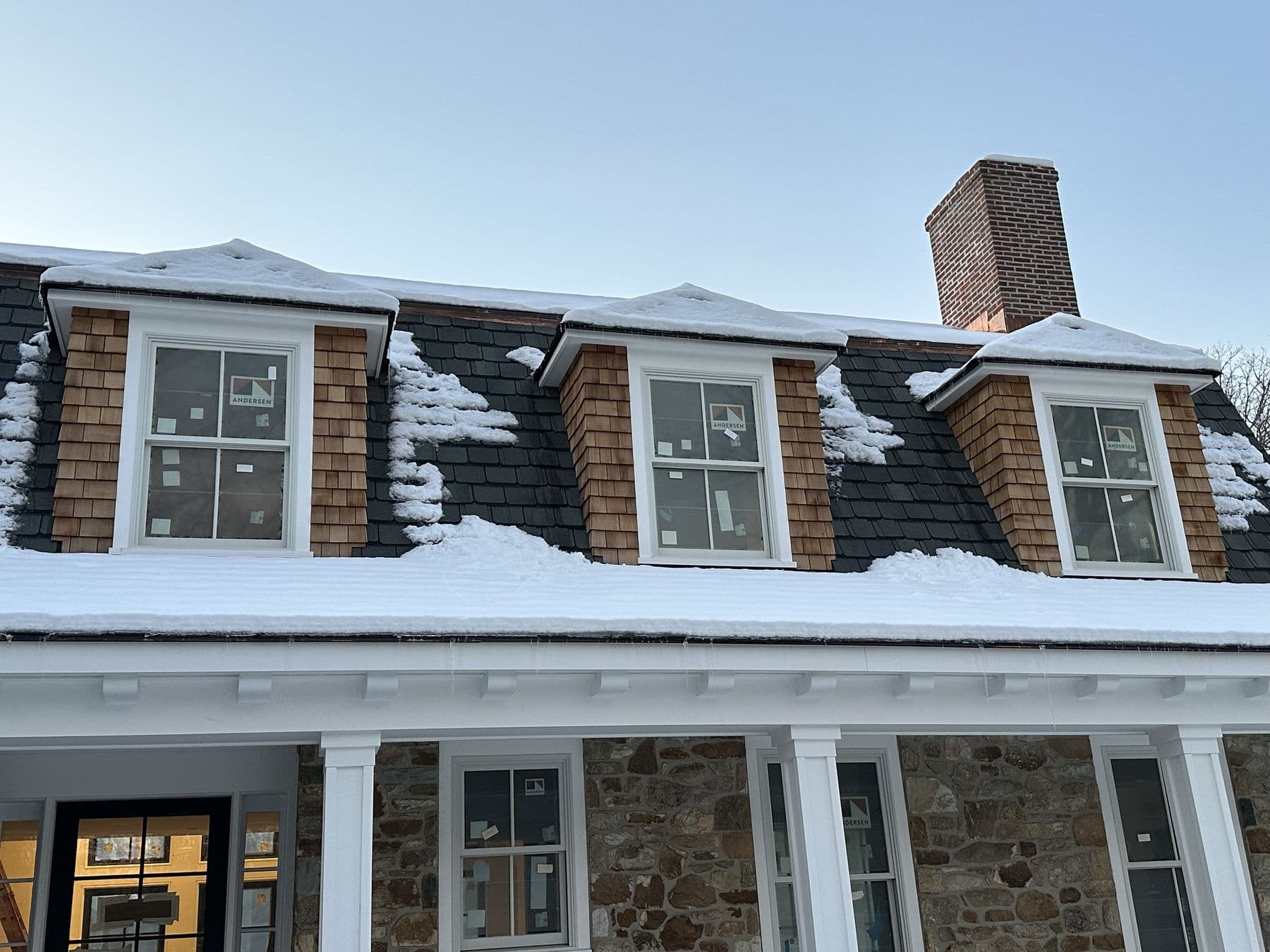
Crown is not only an interior trim. On older houses you also see it at the cornice and on gable returns, where it finishes the roof edge. Exterior crown should be PVC or a rot-resistant wood, primed on all six sides, and flashed above so water does not sit on top of it.
 Lower Merion TwpApr 2026
That gable return on a Lower Merion cottage has crown that ties into a copper gutter against the stone. Exterior crown like that is part of our exterior trim work, not interior finish carpentry, and it is priced differently because of ladders, flashing and weather.
DIY or hire it
Crown is a classic weekend project, and plenty of homeowners do a good job in a small, square room. The problems start with long walls, out-of-square corners, heavy profiles and high ceilings. If you try it yourself:
- Buy 15 percent more molding than the wall length to cover waste and test cuts.
- Practice cuts on scrap until you understand the spring angle.
- Cope the inside corners instead of mitering them.
- Paint the crown before installing it, then touch up.
If you hire it out, ask how they handle inside corners, whether blocking is included for large profiles, and whether paint is in the price.
Combining crown with other trim
Crown is often done together with other finish work, and doing it together saves money because the carpenter is already set up in the room. Common pairings are:
- Crown and new baseboard, so the top and bottom of the room match.
- Crown and window and door casing, when windows are being replaced.
- Crown and wainscoting or picture-frame molding in a dining room. See our wainscoting cost guide.
- Crown and built-ins, so the top of a bookcase dies into the ceiling trim.
If you are planning more than one of these, ask for them in one estimate.
Paying for trim work in Pennsylvania
Home improvement contracts over $500 must be in writing in Pennsylvania, and you can cancel within three business days of signing. For larger jobs the deposit is capped at one third of the price plus special-order materials. A trim carpenter should give you a written price before starting, even for one room.
Questions people ask about crown molding
How long does it take to install crown molding in one room? A simple square room with 8 foot ceilings is usually half a day to a day of carpentry, plus paint. Rooms with many corners, tall ceilings or built-up crown take longer.
Is crown molding still in style? Yes, especially in older houses and in dining rooms, living rooms and entry halls. Simpler, smaller profiles suit newer houses; larger, built-up profiles suit older houses with taller ceilings.
Should crown match the baseboard? It should match the style and finish of the room's trim, not necessarily the exact profile. A good rule is that crown is a little taller than or about the same height as the baseboard.
Can crown go on a vaulted or sloped ceiling? Yes, but the cuts get more complicated where the slope meets a flat ceiling or a wall. Some sloped rooms look better with a flat frieze board instead.
Does crown molding add value to a house? It adds finish and makes rooms feel complete. It is a small cost compared to other improvements and buyers notice it in main rooms.
See our finish carpentry service, the siding, windows and doors job in Broomall, and our guide on trim carpentry versus finish carpentry.